

The market grows – profitable growth stays out of reach
The first edition of the Income Market Monitor brings every public data source together into a single picture of the Dutch income protection market: size, growth, market shares and profitability, by product market and by player.
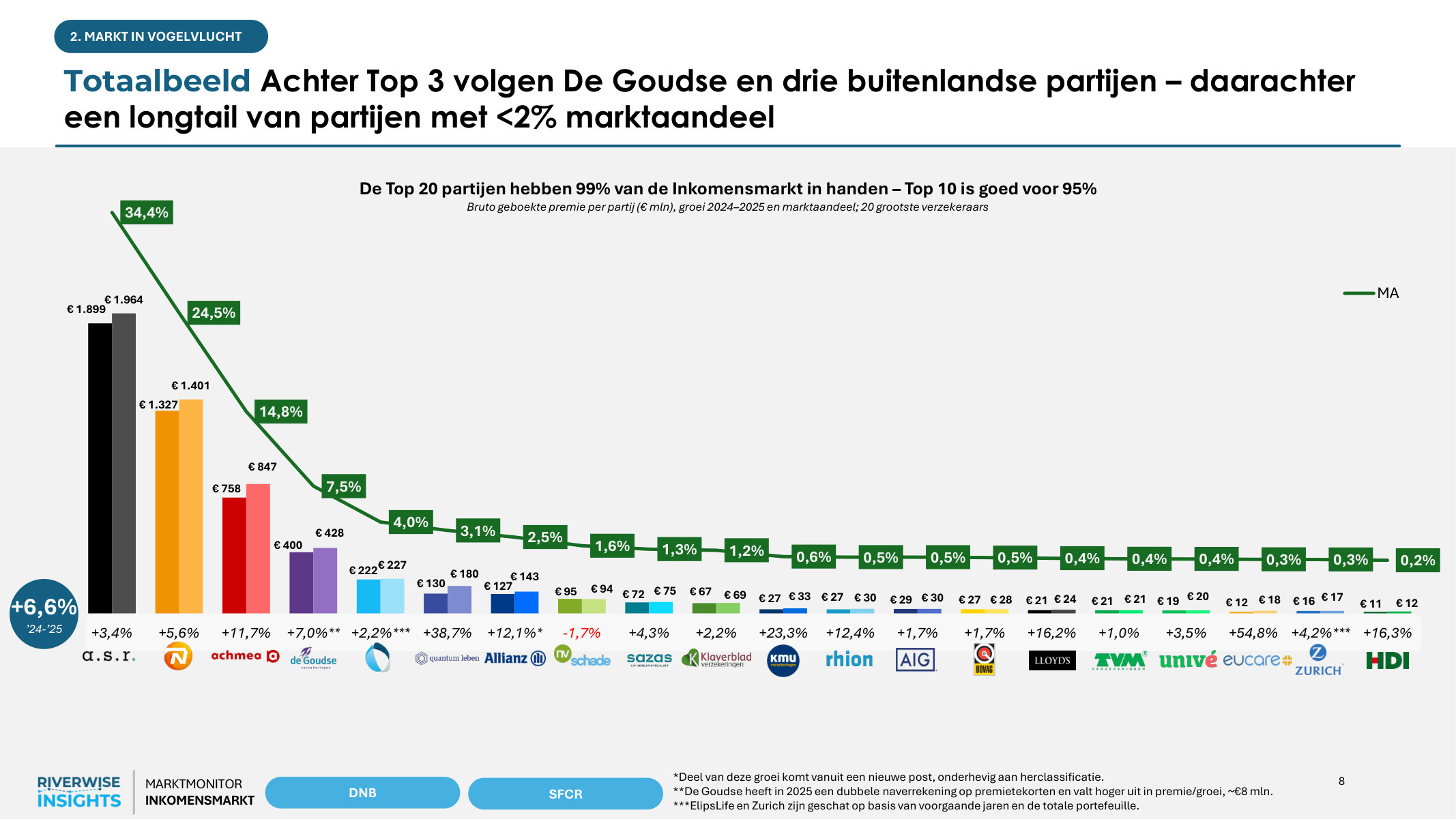
The Dutch income protection market wrote €5.7 billion in gross premiums in 2025, up 6.6% on 2024. That growth is not profitable: the group market — largely absenteeism and WIA — closed 2025 with a result of -7% of earned premium. The three large Dutch insurers grew more slowly than the market at 5.7%, while foreign players grew fastest at 14.5%. The combined market share of the Top 3 now stands at 73.7% — and is falling.
Individual disability (AOV) is shrinking, WIA/WGA premiums are rising mainly to keep pace with mounting claims, and so insurers are concentrating on absenteeism — where premiums as a share of payroll are falling and the MGA market is making a technical loss. The report maps that dynamic: size and growth by product market, market shares of the twenty largest players, profitability by cluster and by player, and a separate cut of the MGA market. Built bottom-up from public sources, and repeated every year from now on.
An example from the research
What the report covers
- The full market build-up 2023–2025, by product market — absenteeism, individual disability (AOV), WIA top-up, WGA own-risk and accident — and by cluster of insurers.
- Market shares and growth of the twenty largest players, including foreign insurers traced through their SFCR reports.
- Profitability: combined, claims and expense ratios over ten years, group versus individual, and by player.
- Deep dives on absenteeism, AOV and WIA/WGA – from premium levels and absence rates to the self-employed and UWV backlogs.
- A separate cut of the income managing general agent market, including the build-up of the combined ratio in absenteeism MGAs.